THE IMMACULATE CONCEPTION
One is my dove, my perfect one is but one,
she is the only one of her mother,
the chosen of her that bore her…
Who is she that looketh forth as the morning,
fair as the moon, clear as the sun,
and terrible as an army with banners?
Song of Solomon 6, 9-1
Fear not, for I have redeemed you.
I have called you by name, you are mine.
Isaiah 43, 1
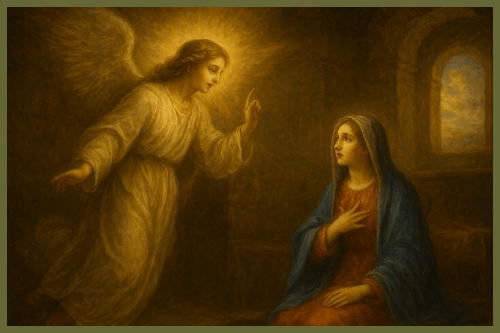
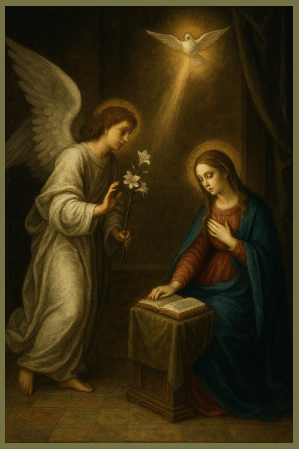
And the angel being come in, said unto her:
Hail, full of grace, the Lord is with thee:
blessed art thou among women.
Luke 1, 28 {DRB}
καὶ εἰσελθὼν ὁ ἄγγελος πρὸς αὐτὴν εἶπεν
Χαῖρε κεχαριτωμένη ὁ κύριος μετὰ σοῦ
εὐλογημένη σὺ ἐν γυναιξίν
The Song of Solomon, also known as the Song of Songs, is a book in the Old Testament of the Bible attributed to King Solomon. This text is often characterized by its rich imagery and poetic structure and is considered one of the most unique books in the Bible, focusing on themes of love and desire. As a piece of poetry, the Song of Songs diverges from the Old Testament’s primarily legal and historical texts, offering a more personal and emotional exploration of love. This reflects a broader biblical theme of romantic love and desire, often viewed as a metaphor for the relationship between God and Israel.
Throughout history, interpretations of this passage have varied significantly. Some early Jewish scholars viewed it as an allegory depicting the relationship between God and His people. In Christian interpretation, it has often been seen as a symbol of Christ’s love for the Church. The verses encapsulate adoration and a sense of exclusivity, underscoring the intimacy of the beloved, which can be understood as symbolic of a spiritual bond.
The description of the beloved as “fair as the moon” and “clear as the sun” evokes imagery of beauty and brilliance, signifying not only physical attractiveness but also spiritual purity. The line introducing the idea of her being “terrible as an army with banners” suggests strength and power, merging the tender with the formidable, which can be interpreted in various ways depending on the reader’s perspective. When considering this passage in the context of Daughter Zion and the Virgin Mary from a Catholic perspective, we can draw significant parallels that highlight their unique roles and attributes.
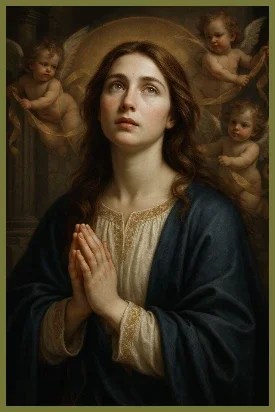
In biblical literature, Zion often symbolizes the people of Israel and the city of Jerusalem, representing not just a geographical location but also a spiritual and religious identity. Daughter Zion is often personified as a figure that embodies the nation’s collective identity. In this context, the verse celebrates her distinctiveness and beauty, suggesting that she is cherished and unique among her “mother.” This could underscore themes of divine love and election as Israel is depicted as God’s chosen people. The attributes described—” fair as the moon, clear as the sun”—evoke a sense of purity and unmatched beauty, reflecting the idea of Zion being radiant due to her relationship with God.
When applied to the Virgin Mary, the language becomes even more layered. In Christian theology, Mary is often seen as the ideal woman, chosen to bear the Son of God. The description of her as “the only one of her mother” resonates with the understanding of Mary as singularly significant in salvation history. The phrase “chosen of her that bore her” can also reflect how Mary is selected by God to fulfill a pivotal role, much like Daughter Zion is portrayed in the Hebrew scriptures. The text’s imagery of beauty aligns with the way Mary is revered in Christian tradition—her purity, grace, and role as the Mother of Jesus make her a figure of exceptional worth. The line “terrible as an army with banners” can reflect the strength and power that Mary embodies through her faith and obedience to God’s will, as well as her role in spiritual warfare against sin and evil.
Combining these interpretations, the text expresses a deep sense of honor and reverence for both Daughter Zion and the Virgin Mary. Each figure represents a vital connection to the divine—Daughter Zion as a representation of God’s chosen people and Mary as the bearer of divine grace. Altogether, the passage emphasizes the themes of uniqueness, beauty, and divine choice, celebrating the special relationships between God, his people, and the pivotal figures in salvation history (See Revelation 12).
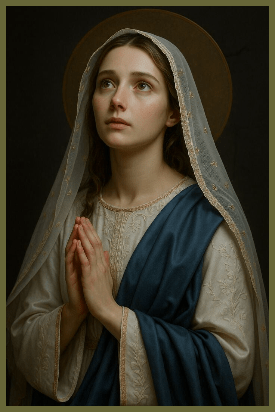
Isaiah 43:1, which states, “Fear not, for I have redeemed you. I have called you by name; you are mine,” emerges from a profound historical context that speaks to Israel’s identity and redemption, often personified as Daughter Zion. In this verse, God directly addresses the people of Israel during a time of turmoil and exile, offering assurance and hope. The promise of redemption reflects God’s enduring love and commitment to His chosen people, despite their suffering and struggles.
Daughter Zion, as a symbol of Jerusalem and the nation of Israel, embodies the collective identity and spiritual heritage of the people. This verse reinforces the idea that Israel is not merely an abstract entity, but a beloved and cherished figure known intimately by God. The phrase “called you by name” suggests a deep personal relationship, indicating that each individual within the nation is recognized and valued. Daughter Zion stands out as a representation of divine election and grace, accentuating the unique bond between God and His people.
In the New Testament, in Luke 1:28, the angel Gabriel greets Mary with the title “kecharitomene,” meaning “full of grace.” This greeting situates Mary in a unique theological lineage that resonates with the understanding of Daughter Zion. Just as Daughter Zion is portrayed as a figure of beauty and purity, Mary is honored for her singular role in salvation history as the Mother of the divine Messiah. The connection here is profound; both figures embody divine favor and grace, marked by their roles in God’s redemptive plan.
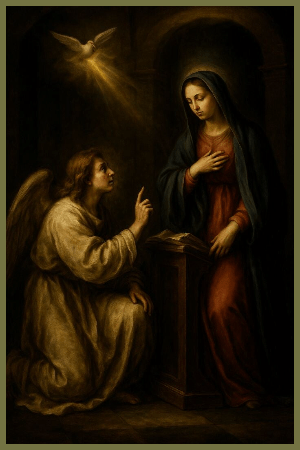
The female vocative kecharitomene (κεχαριτωμένη), literally “highly favored by grace” or “having been graced” ₁ can be paraphrased as “enduringly endowed with grace.” ₂ It is because Mary was to be the mother of our Lord that the perfect past participle does “show completeness with a permanent result” and denotes “continuance of a completed action.” ₃ Moreover, since the expression kecharitomene is in the female vocative case, the angel addresses Mary by identifying her as the embodiment of all that this expression denotes. When Gabriel greets her, he doesn’t call Mary by her given name but by the fullness and endurance of her state of holiness. He names her perfected in lasting grace.
Here, we have the morphological aspectual (not tense-marked) stem of kecharitomene: ke. This is the perfect stem of the root verb charitoo (χαριτόω), which may denote a perpetuation of a completed past action (mene). The root verb is derived from (χάρις), which means “grace” or “favor.” The completed past action itself, therefore, is “having been highly favored and made acceptable by grace,” “lovely or agreeable.” ₄
The perfect stem is distinguished from the aorist stem, as in Ephesians 1:6, for example, escharitosen (ἐχαρίτωσεν): “He graced” or “has freely bestowed grace.” In this active indicative form, the aorist stem describes a completed action that has come to pass and is finished. It is temporal in aspect and a momentary result. ₅ The aorist stem does not signify a permanent state of grace. On the other hand, the perfect aspect exclusively denotes a state that prevails after an event has occurred and is caused by this event.
Catholics believe this past occurrence to be Mary’s Immaculate Conception – the first instant when God fashioned and sanctified Mary’s soul and redeemed her in the most perfect way, in view of the foreseen merits of Christ, because of her election to the Divine Maternity. By His gracious act, God redeemed Mary perfectly by preserving her from contracting the stain of original sin and all personal sins so that she would be the most acceptable and loveliest mother of the Divine Word in his humanity. For no other reason did God favor Mary with this singular grace. ₆
The perfect tense in linguistic terms may denote that an action is already completed, but it can also convey the sense that the effects or results of that action continue to persist into the present moment. For instance, when our Lord states, “It is written” (in Greek, gegrapti/Γέγραπται), this can be interpreted literally as “It has been written.” This phrase suggests that what has been inscribed retains its validity and authority beyond the initial moment of writing. Consequently, this emphasizes the theological assertion that “Man cannot live by bread alone, but by every word that comes from the mouth of God” (Mt 4:4), signifying the enduring relevance of divine revelation.
Moreover, the perfect tense may implicitly suggest future implications within its aspectual framework. For example, Ephesians 1:6 highlights our predestination to grace, which stands in contrast to predestination to glory. However, it is essential to understand that within the context of the active indicative aorist—an aspect that modifies the root verb and is temporal in its nature—there is an indication that not every individual will persist in a state of grace beyond their current experience. Therefore, the term escharitosen suggests that there is no guarantee of a permanent state of sanctifying grace for all believers, illustrating that the concept of “Once saved, always saved” does not hold universally true when viewed from a distributive perspective. This conveys that the dynamics of faith and perseverance are essential in the Christian experience, emphasizing a continuing commitment to grace rather than a one-time transformation.
In Catholic theology, sanctifying grace is intricately linked to human actions and our ongoing cooperation with God’s actual graces. This connection underscores the importance of St. Paul’s exhortation to the faithful, urging them “not to receive God’s grace in vain” (2 Cor 6:1). This warning highlights that the soul’s justification—its declaration of righteousness before God—is fundamentally rooted in the presence of sanctifying grace. In this context, sanctification serves as the formal cause of justification; it is the process through which individuals are made holy and acceptable in God’s sight. However, sanctifying grace is precarious; the soul becomes deprived of this grace by committing a mortal sin, which leads to spiritual death, as outlined in 1 John 5:16-17. This emphasizes the gravity of sin and the urgent need for repentance and divine mercy.
In considering the unique role of Mary in salvation history, it’s essential to acknowledge that God’s grace bestowed upon her was enduring and profound. Her selection as the Mother of God was not a random act but a deliberate choice by divine providence, resulting in a permanent state of grace. This theological position presupposes that Mary, full of grace (Lk 1:28), was preserved from original sin and never committed personal sins. Consequently, she maintained her sanctifying grace throughout her life, which allowed her to fulfill her pivotal role in the Incarnation of Christ without any loss of holiness. This doctrine underscores Mary’s exceptional purity and unique relationship with God, setting her apart as a model for all believers.
Here are some scriptural comparisons between the perfect and aorist aspects of verbs to better distinguish them.
“By grace, you have been saved.”
– Ephesians 2:5
Christ’s formal redemption of the world continues. The grace of justification and forgiveness our Lord has merited for humanity is the permanent result of his passion and death on the cross. God has reconciled the world to Himself through our Lord and Savior Jesus Christ (Rom 5:10-11).
“After that, you believed (Aorist), you were sealed (aor.) with the Holy Spirit.”
– Ephesians 1, 13
Believing and sealing are definite and complete acts confined to the present moment. Some of the Ephesians who believed, therefore, may eventually have lost their faith and fallen from grace. St. Paul is referring to their predestination for grace rather than glory.
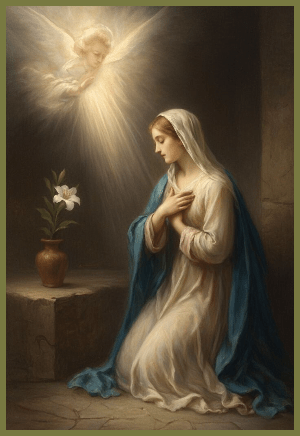
In examining the significance of Luke 1:28, it is crucial to note that the original Greek text employs the term “kecharitomene” rather than the more commonly interpreted phrase “pleres charitos” (full of grace). The term “kecharitomene” is a perfect passive participle presented in the singular female vocative form, specifically addressing Mary. A participle serves as a verbal adjective that conveys the qualities or state of the subject to which it refers. The perfect tense of this participle indicates an action—namely, the divine bestowal of grace—that is not only ongoing but also has a completed result. By using “kecharitomene” as a title, the evangelist conveys a message that transcends the limitations of time, suggesting that Mary’s state of being is not confined to the immediate moment of the angel’s announcement. The angel proclaims: “Hail, you who are completely, perfectly, and permanently endowed with sanctifying or justifying grace.” This profound declaration implies that Mary is endowed with grace in its fullest sense indefinitely.
To be “completely endowed with grace” equates to being “full of grace,” indicating that she is the ultimate recipient of divine favor. This unique and perfect endowment of grace is described as a completed past action, possessing a lasting effect that does not change over time. Thus, Mary is acknowledged for her exceptional status and identified by it. In her interior life, Mary embodies the qualities necessary to fulfill her role as the mother of God incarnate. She is portrayed as completely and perpetually sinless, with her soul being devoid of any stain of sin. This immaculate state highlights the theological principle that grace counters sin, serving as the antidote that preserves her purity and sanctification. Therefore, Mary represents the ultimate ideal of holiness and grace, uniquely prepared for her divine mission.
Thus, the appellation “Kecharitomene,” found in the Greek text, carries with it a depth of meaning that signifies not just a momentary state but a permanent condition bestowed upon Mary. This can be paraphrased in Latin as “gratia plena,” or “full of grace,” indicating that Mary has been endowed with a fullness of sanctifying and justifying grace. This extraordinary endowment renders her completely holy and perfectly equipped to respond to her divine call, showcasing her unparalleled role in salvation history. Thus, the depth of this title encapsulates both her unique election by God and her exceptional readiness to fulfill the profound mission of divine motherhood central to Christian belief.
In order for Mary to conceive and bear the Son of God as a mother truly worthy of Him, the spiritual gifts of faith and fortitude, while abundant and well-sourced within her soul, would not have sufficed for the immense divine calling placed upon her. Mary needed to embody perpetual holiness in every facet of virtue—from the moment of her conception, celebrated in the doctrine of the Immaculate Conception, to the time of her Dormition, when she was assumed into heaven. This lifelong Divine Maternity required an unwavering commitment to justice and holiness in her soul, as well as to immaculate bodily purity throughout her earthly existence. Mary’s exemplary life, marked by profound humility, obedience, and love, serves as the ultimate model of maternal devotion and fidelity to God’s will, laying the foundation for her unique role in the Incarnation of Christ. Thus, her sanctity was not a mere aspect of her being but an essential qualification for her divine mission.
In Ephesians 2:5, the Greek term for grace is “charis,” derived from the root verb “charitoo.” This linguistic connection is significant, especially when considering the expression “kecharitomene,” a pivotal descriptor used in reference to Mary. The grace bestowed upon her—central to the doctrine of her Immaculate Conception—can be understood as sanctifying grace and a form of justification. According to Catholic teaching, God graciously conferred this extraordinary grace upon our Blessed Lady at the precise moment of conception. This divine act was predicated on the foreseen merits of Christ, emphasizing that her sanctification was not merely reactive but a part of God’s eternal plan for salvation. The perfect stem indicated by “ke” in “kecharitomene” suggests that her redemption is complete and permanent from the first instant of her conception in the womb.
Mary, chosen to be the Mother of Jesus Christ, was liberated from the weight of mankind’s collective guilt through her Immaculate Conception, a grace reflected in Genesis 3:15. This profound event set her apart, allowing her to embody a sanctity free from original sin. It is this divine favor that explains why the angel Gabriel greeted her with the words, “Fear not, for you have found grace with God” (Luke 1:30). Mary’s existence was marked by a complete absence of sin, enabling her to demonstrate an unparalleled love for God and a genuine fellowship with her neighbors. Her heart was entirely devoted to the divine will, so she had no reason to be anxious about divine justice or the consequences of sin. Fear, which is often associated with the anticipation of punishment, was inconceivable for her, as perfect love, as stated in 1 John 4:18, casts out all fear.
Hence, the basic thought of the Greek perfect tense is that the progress of an action has been completed, and the results of the action are continuing in full effect. The progress of the action has reached its culmination, and the finished results are now in existence. Unlike the English perfect tense, which is used to express actions that began in the past and continue in the present, the Greek perfect tense indicates the continuation and present state of a completed past action. For instance, Galatians 2:20 should be translated as “I am in a present state of having been crucified with Christ,” indicating that not only was Paul crucified with Christ in the past, but he exists now in that present condition. The apostle continues: “The life I now live in the body, I live by faith in the Son of God, who loved me and gave himself for me.” The Greek perfect tense refers to a person’s present condition or state that has resulted from the past.
Luke informs us that the extraordinary grace bestowed upon Mary was not just a momentary blessing but a profound state of grace that she continually lived in, beginning long before the Annunciation. It is reasonable to infer that Mary remained in this elevated state of grace even after the angel Gabriel departed, as he left promptly following her acceptance of God’s will to become the blessed mother of the Lord. This signifies that her cooperation with divine grace was part of a deeper relationship with God. The angel’s declaration in Luke 1:30, in which he reassures Mary, “Fear not, Mary, for you have found favor (grace) with God,” highlights the uniqueness of her situation. This favor is not to be understood as a transient gift; rather, it represents a continuous and profound relationship with divine grace that predated her conception of Christ. The implication here is significant: Mary’s state of grace is rooted in a completed action in the past, likely occurring at the moment of her creation.
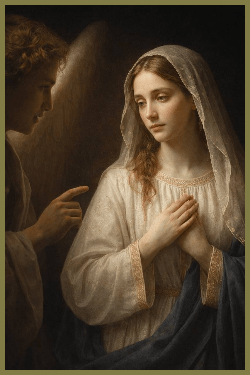
God commissioned the angel Gabriel to greet the Blessed Virgin Mary with the title “Kecharitomene,” meaning “full of grace.” This title reflects her unique and pristine form of redemption, as prophesied in Isaiah 43:1, highlighting her exceptional status among all human beings. By the merits of her divine Son, Jesus Christ, Mary was granted an unparalleled privilege: She was preserved from original sin from the moment of conception. This divine intervention meant that she did not merely have her sinfulness remitted; rather, she was exempted entirely from the universal debt of sin that afflicts humanity. In acknowledgment of her unparalleled purity and sanctity, the Lord bestowed upon her “great things,” as noted in Luke 1:49. These “great things” signify not only her exalted role as the Mother of God but also the extraordinary grace and blessings that surrounded her life, setting her apart as a model of virtue and devotion in the divine plan of salvation. From her conception onward, her life was marked by a unique cooperation with God’s will, culminating in her pivotal role in the Incarnation.
In his Apostolic Constitution, Ineffabilis Deus, issued on December 8, 1854, Pope Pius IX articulates the concept of the Divine Maternity as the “Supreme reason for the privilege” of the Immaculate Conception. This declaration emphasizes the profound significance of Mary’s role as the Mother of Christ and underscores the unique grace bestowed upon her. When God lovingly predestined Mary to be the mother of our Lord, He foresaw her acceptance of this divine mission—her Fiat—at the very moment He created and sanctified her soul.
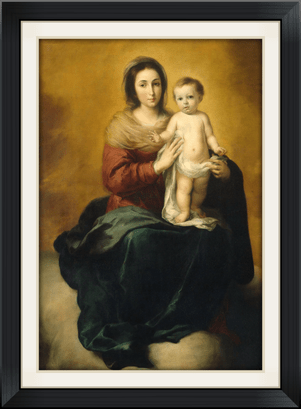
It is important to note that using the perfect tense in this context does not imply that Mary’s state of grace will unconditionally persist indefinitely. The Apostle Paul illustrates a similar theological point when he expresses that he remains crucified with Christ, contingent upon Christ living within him. This is a reflection of active participation, as Paul lives his life “by faith in the Son of God,” echoing the notion that, similarly, Mary continues to abide in a state of sanctifying grace and justification before God, contingent upon her unique role as the Mother of our Divine Lord. Moreover, God adorned the Mother of the Son with “garments of salvation” and clothed her in a “robe of righteousness” (Isaiah 61:10), signifying her unparalleled dignity and holiness, which make her the most worthy vessel to bear the Son of God. This rich theological tapestry highlights Mary’s singular grace and the divine plan that reverberated throughout salvation history, culminating in her pivotal role in the Incarnation.
The epithet “Kecharitomene,” or “Full of grace,” emphasizes a profound aspect of Mary’s interior life and her unique relationship with God. Unlike a mere description, this designation asserts that she embodies the very essence of grace—completely, perfectly, and perpetually endowed with sanctifying and justifying grace. This distinction is not trivial; it highlights her singular role in salvation history. The names God bestows upon His servants are not arbitrary; they carry a sense of permanence and originate from eternity, reflecting His divine design and intention. To fully grasp what the title Kecharitomene reveals, it is essential to consider both its grammatical nuances and its linguistic context. Specifically, the perfect tense in this instance is extraordinary and unparalleled in the Scriptures, reserved solely for the Blessed Virgin Mary, the Mother of God. This grammatical choice underscores her unique status in the hypostatic order of grace and the objective redemption of humanity, illuminating the deep theological significance of her role as the one chosen to bear the Incarnate Word. Thus, Mary is not a passive recipient of grace but an active participant in collaboration with the Holy Trinity (Lk 1:38).
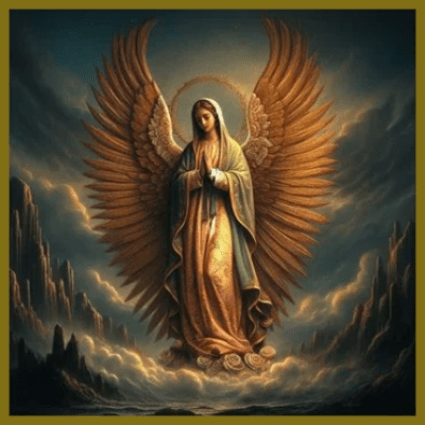
The woman was given the two wings of a great eagle,
so that she might fly to the place prepared for her in the wilderness,
where she would be taken care of for a time, times and half a time,
out of the serpent’s reach.
Revelation 12, 14
EARLY SACRED TRADITION
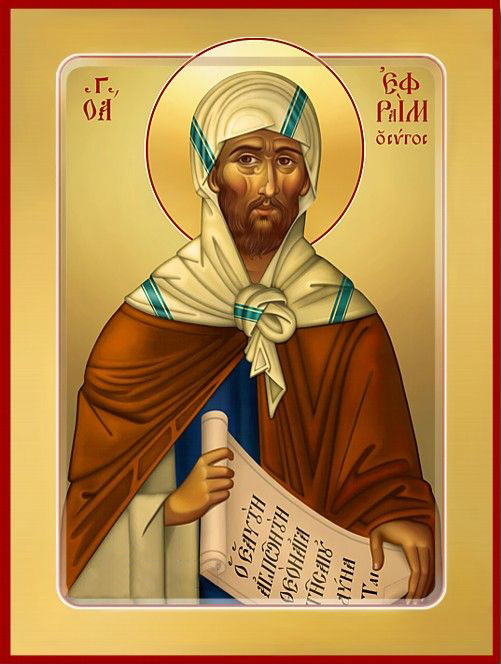
St. Ephraem of Syria
Nisibene Hymns 27:8
(A.D. 361)
“You alone and your Mother are more beautiful than any others,
for there is no blemish in you nor any stains upon your Mother.
Who of my children can compare in beauty to these?”
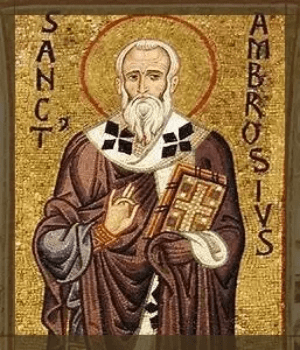
St. Ambrose, Sermon 22:30
(A.D. 388)
“Mary, a Virgin not only undefiled but a Virgin whom grace
has made inviolate, free of every stain of sin.”
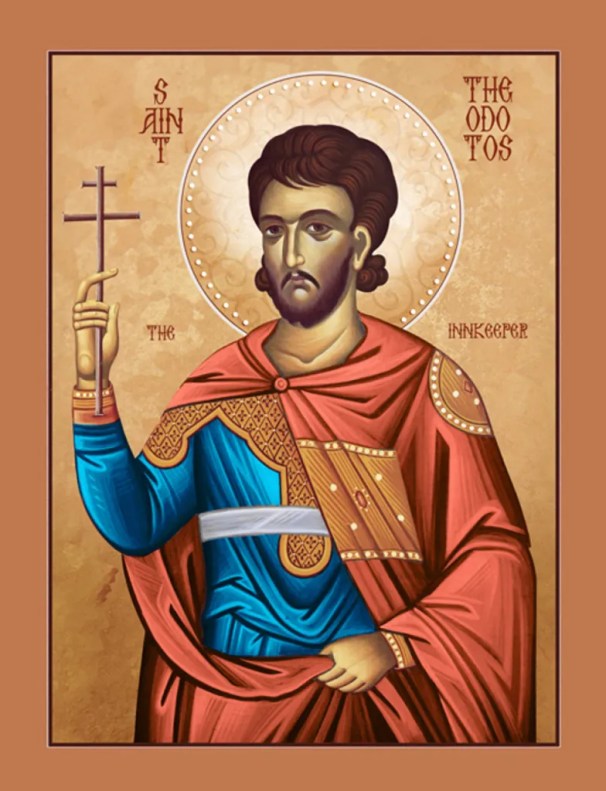
St. Theodotus of Ancyra, Homily VI:11
(ante A.D. 446)
“A virgin, innocent, spotless, free of all defect,
untouched, unsullied, holy in soul and body,
like a lily sprouting among thorns.”
St. Peter Chrysologus, Sermon 140
(A.D. 449)
“The angel took not the Virgin from Joseph,
but gave her to Christ, to whom she was pledged
in the womb, when she was made.”
St. Theoteknos of Livias
Panegyric for the Assumption, 5:6
(A.D. 650)
“She is born like the cherubim,
she who is of a pure, immaculate clay.”
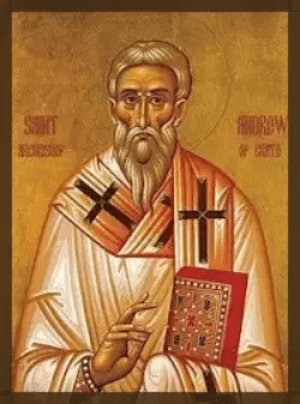
St. Andrew of Crete
Sermon I, Birth of Mary
(A.D. 733)
“Today humanity, in all the radiance of her immaculate nobility, receives its ancient beauty.
The shame of sin had darkened the splendour and attraction of human nature; but when the
Mother of the Fair One par excellence is born, this nature regains in her person its ancient
privileges and is fashioned according to a perfect model truly worthy of God…. The reform of
our nature begins today and the aged world, subjected to a wholly divine transformation,
receives the first fruits of the second creation.”
SALVE REGINA
Notes & Sources
[1] Fred P Miller, Zechariah & Jewish Renewal: From Gloom to Glory (Lithonia: Moellerhaus Publishing, 1992). See the author’s commentary on Zechariah 20 in Chapter 31 in the context of Luke 1:42. Elizabeth blesses or praises Mary for “having been [already] blessed” (eulogemene). The perfect passive participle of the verb eulogeo functions as it does in Luke 1:28 in which the angel Gabriel names Mary “having been graced.”
[2] Friedrich Blass & Albert Debrunner, Greek Grammar of the New Testament (Chicago University Press, 1961),175.
[3] Herbert Weir Smyth, Greek Grammar (Harvard University Press, 1968), 108-109.
[4] James H Strong, Strong’s Exhaustive Concordance of the Bible (UK: Hendrickson Publishers, 2009). [5487. Charitoo]
[5] Blass & Debrunner, 166.
[6] Fritz Rienecker & Cleon Rogers, A Linguistic Key to the Greek New Testament (Grand Rapids: Zondervan Christian Publishing, 1976). The authors state that Kecharitomene denotes “grace having been bestowed on” someone as “a divine favor for a special vocation.”
 Salve Regina